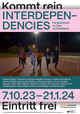
Interdependencies: Perspectives on Care and Resilience

Opening: Friday, October 6, 2023
The group exhibition Interdependencies: Perspectives on Care and Resilience shows the mutual dependencies that exist between people, societies, and institutions. The fourteen artists offer critical, solution-oriented perspectives on social relationships and power structures. At its heart lie individual and collective experiences of disability, illness and healing. The desire for justice, the pressing need for resistance and the importance of creativity in the charged zone between vulnerability and resilience are central to their works.
We have all experienced the difficulties caused by the COVID-19 pandemic, whether due to isolation, illness or adapting to new situations. What has changed most since then is the way in which we take care of one another – both in health care and at the workplace, and in our interpersonal relationships. Yet it is not only since the pandemic that there have been shortcomings in social and institutional care – the most vulnerable members of our society are especially caught up in this situation. The discourse around care has increasingly become a major topic of the day, however. Artists are increasingly creating models that reject ableism, gender norms and social pressure to achieve. The artists in the exhibition are committed to the visibility and equality of people with disabilities and are involved in queer and feminist movements that demonstrate their readiness for change and for resistance.
In the exhibition, the focus is on three models of care – self-care, political care and collective care. For many people, self-care offers space away from the harsh realities of capitalist pressure to achieve. Yet at the same it is a privilege. In the installation Depression Maryam Jafri critiques the appropriation of traditional Chinese healing practices by a global wellness industry. Ezra Benus explores the relation between disease, capitalism and eroticism, and takes as their theme the way in which lived experiences are turned into consumer goods.
Care and care work are not only a private matter, but also a political one. For some artists in the exhibition, political care means engaging in activism and pointing out grievances in their work in order to bring about change. Brothers Carmen and Antonio Papalia not only take care of each other in their artistic practice, but also resist the pharma industry by cultivating alternative pain killers in the form of cannabis plants. Similarly, Sharona Franklin investigates with her quilt made of gelatine, herbs and biomaterial the power dynamic between the pharma industry and alternative healing methods; moreover, she is a disability rights advocate. The specific discrimination and stigmatisation of persons with disabilities or chronic illnesses are described as ableism. Ableism is frequently interwoven with other structural disadvantages, such as poverty, sexism and/or racism. Carolyn Lazard, in her modified Pain Scale, points out the unequal treatment of people of colour, whose pain is taken less seriously by medical personnel than that of white persons.
Collective care and cooperation are central to enabling care for all. This concerns not only institutionalised care work, but also the collective willingness to commit to better conditions overall. The exhibition shows approaches that are based on solidarity, empathy and support, and questions and expands upon traditional notions of care. Both the works of Rory Pilgrim and the vacuum cleaner are preceded by a collective care and work process. While Pilgrim examines the relationship between the climate crisis and social support, the vacuum cleaner tackles in his video installation the theme of the failing psychiatric health system, and the power of art to promote resilience –the ability of individuals or societies to deal with changes and crises and to adapt to them.
In the museum, too, we wish to take care of different needs. The Caring Space enables visitors to the exhibition to retreat into a space conceived for them and to take a break from everyday life. Here, we invite our visitors to share their experiences and thoughts related to the subject of care, and to leave them behind.
The exhibition will include a publication, an extensive public programme and a symposium.
With works by: Adina Pintilie, Carmen & Antonio Papalia, Carolyn Lazard, Ezra Benus, Grace Ndiritu, Jesse Luke Darling, Johanna Hedva, Lauryn Youden, Maryam Jafri, Rory Pilgrim, Sharona Franklin, the vacuum cleaner and collaborators, Alina Szapocznikow and Marijke van Warmerdam.
Curator: Dr. Michael Birchall
Assistant Curator: Claudia Heim
Artist Lauryn Youden has recorded a podcast to accompany her work Venus in Scorpio, on view in the exhibition: listen here